Keep response time and refresh rate as separate specifications
Compare two actual 0.03-ms-GtG specifications with different refresh rates, and calculate frame intervals without calling them measured input lag.
Updated:
Why are milliseconds and hertz separate questions?
Response time and refresh rate describe different parts of display behavior. A response-time figure needs its measurement label and conditions; a refresh-rate figure describes how often a selected mode refreshes. They cannot be swapped merely because both appear in a gaming advertisement. To compare a 240 Hz monitor properly, retain its resolution, supported input mode and the exact transition-time notation. Do not add or subtract a claimed pixel-transition time from a frame interval and call the result system latency. The following named-model comparison shows why an identical advertised response figure does not make the rest of two monitors identical.
MSI US MPG 271QRX QD-OLED exact specifications ? MSI US MPG 272URX QD-OLED exact specifications ?
Two actual MSI specifications make the difference visible
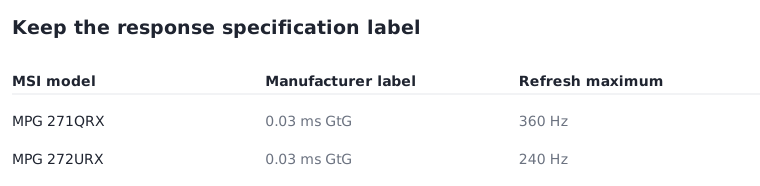
MSI lists 0.03 ms GtG for both MPG 271QRX QD-OLED and MPG 272URX QD-OLED. Their stated maximum refresh rates are 360 Hz and 240 Hz respectively, paired with 2560 by 1440 and 3840 by 2160 resolutions. The GtG label is retained because it is part of the manufacturer’s claim, not silently converted into a different response metric. These values were checked on the exact US specification pages on October 28, 2026. They are manufacturer specifications rather than our transition measurements. No inference is made about every transition, an average result, overshoot or the time between a mouse action and a displayed response.
| Exact model | Advertised transition figure | Maximum mode |
|---|---|---|
| MSI MPG 271QRX QD-OLED | 0.03 ms GtG | 2560×1440 at 360 Hz |
| MSI MPG 272URX QD-OLED | 0.03 ms GtG | 3840×2160 at 240 Hz |
MSI US MPG 271QRX QD-OLED exact specifications ? MSI US MPG 272URX QD-OLED exact specifications ?
Calculate a frame interval with the right label
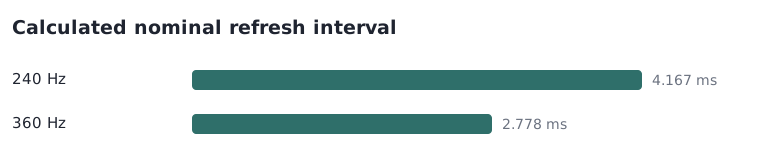
For a refresh rate f in hertz, the reciprocal interval is 1000 divided by f in milliseconds. At 240 Hz that is approximately 4.167 ms; at 360 Hz it is approximately 2.778 ms. The difference between those mathematical intervals is approximately 1.389 ms. These are calculations of nominal refresh intervals, not measured response-time results or a guaranteed reduction in end-to-end input lag. A running application may not deliver a new frame for every refresh, and the source path must actually support the selected mode. Keep the formula and rounding visible so a short numerical result cannot be mistaken for a benchmark.
MSI US MPG 271QRX QD-OLED exact specifications ? MSI US MPG 272URX QD-OLED exact specifications ?
Do not rank unlike response labels as equivalent tests
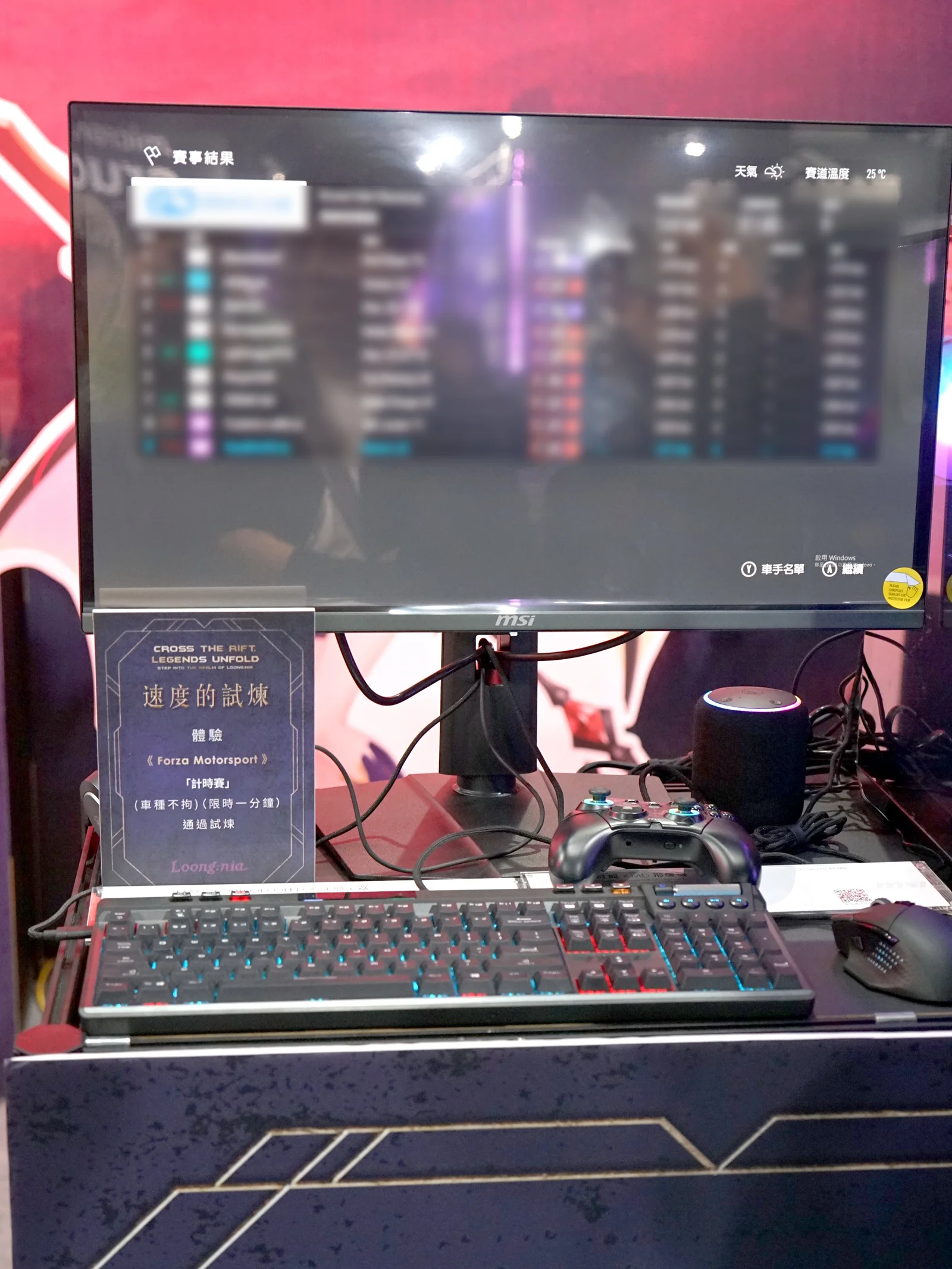
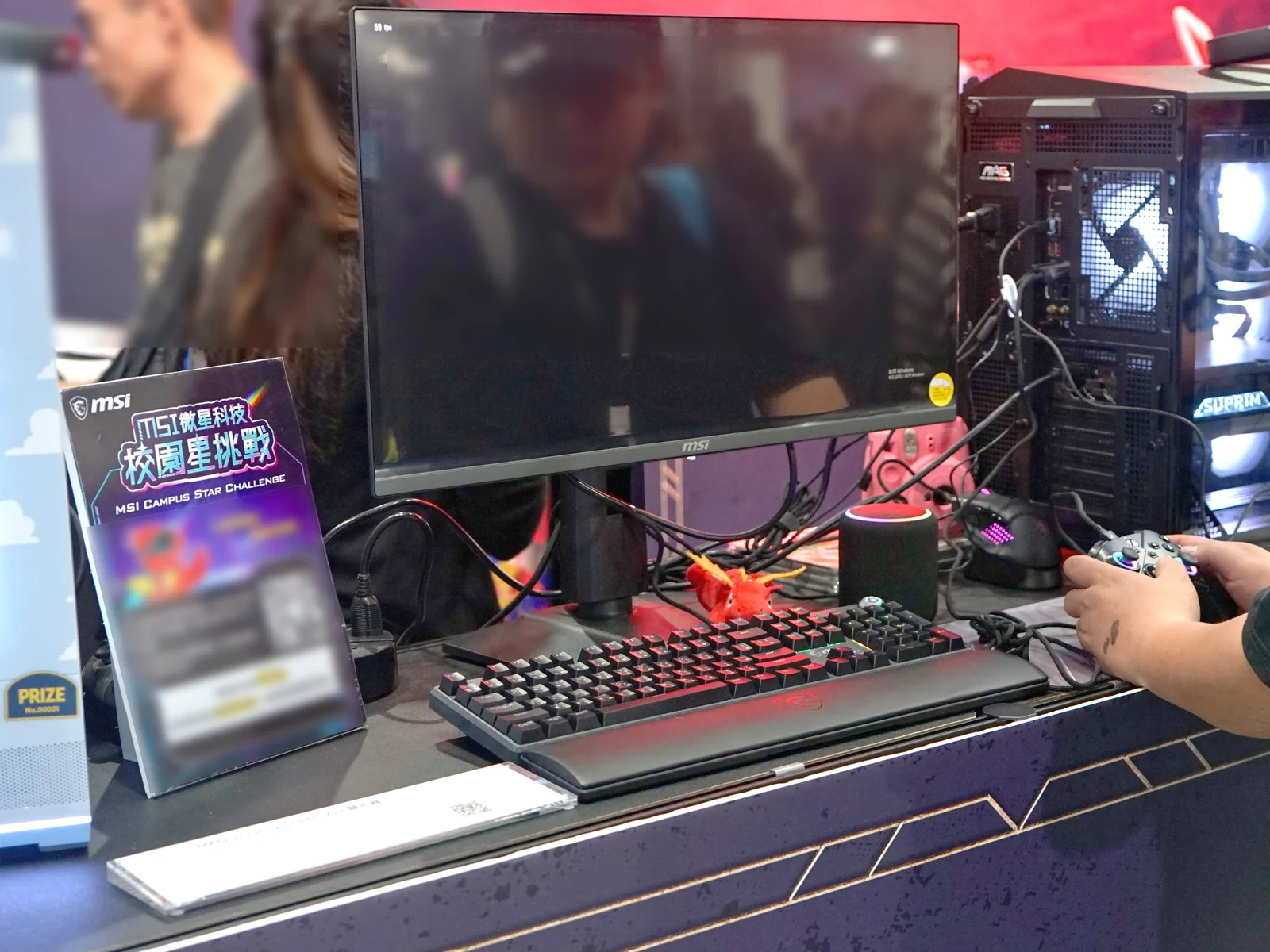
The relevant comparison here preserves the same GtG notation, but even that does not supply a complete transition distribution or identical test methodology. If another listing uses MPRT, an unlabeled fast-time claim, or a mode-specific result, retain that different label and seek the corresponding conditions. A smaller isolated number does not establish the behavior of all moving content. The exhibition photographs are static records of actual screens, not motion tests. Neither a photographed game nor an OLED panel label can establish measured blur, overshoot, input latency or how your particular game will behave.
MSI US MPG 271QRX QD-OLED exact specifications ? MSI US MPG 272URX QD-OLED exact specifications ?
Choose the required mode before interpreting the response claim
If your source and workload require 3840 by 2160 at up to 240 Hz, that documented mode distinguishes the 272URX in this pair. If the required mode is 2560 by 1440 at up to 360 Hz, the 271QRX supplies the different listed option. Verify the complete source, cable and monitor-input path before ordering either. Then look for independent measurements using comparable methods if transition behavior is a deciding requirement; this guide does not invent those results. Preserve the exact model, resolution, rate, response label and open measurement questions in the buying record. Current deals, frame-rate delivery and a universal gaming-performance winner remain unverified.
MSI US MPG 271QRX QD-OLED exact specifications ? MSI US MPG 272URX QD-OLED exact specifications ?